
The Truth About People Pleasing
Saying no is not a display of disrespect. It's an expression of self-respect.

I’m a recovering people pleaser. For most of my life, I didn’t tell the Uber driver the car was freezing or the restaurant server the chicken was undercooked. I said yes to every request that came in, even from classmates who’d bullied me and colleagues who’d badmouthed me.
I thought I was being kind. I no longer believe that.
The root of chronic people pleasing is not concern for others. It’s concern for their acceptance and approval.
Psychologists find that what underlies people pleasing is the fear of being disliked and rejected. When we bend over backward to accommodate others at the expense of our own needs, it’s because we depend on them for self-esteem. Our sense of self-worth rests on their validation. It’s not about their feelings; it’s about how their feelings make us feel.
In a live podcast earlier this year, Kristen Bell explained it hilariously:
After I described people pleasing as selfish, some of the audience disagreed: “It’s not selfish—it’s survival.” I think they got it wrong… and so did I.
I should’ve said that people pleasing is self-focused. We do it because we’re uncomfortable making others uncomfortable. Ironically, it doesn’t ultimately serve their interests. Every time I failed to tell a driver that the car felt like Antarctica, I was setting another passenger up to shiver.
Nothing bad would’ve happened to me if I’d spoken up. I didn’t need to bite my tongue to survive the ride. But the habit did stem from a survival instinct.
People pleasing is based on insecure attachment. We become people pleasers when we discover that others only value us when we’re cooperative to the point of being submissive and deferential. Many girls and women in particular learn that keeping the peace is a strategy for staying safe.
We shouldn’t mistake the past origin of a behavior pattern for the current purpose it serves. A fear of being disliked leads too many of us to put our image above our values. Saying no is not selfish; it’s an act of self-preservation. Setting boundaries is not about letting others down—it’s about standing up for yourself.
Sharing your preferences is not a display of disrespect. It’s an expression of self-respect.
For more, here’s a podcast we did on the science of saying no: Spotify | Transcript
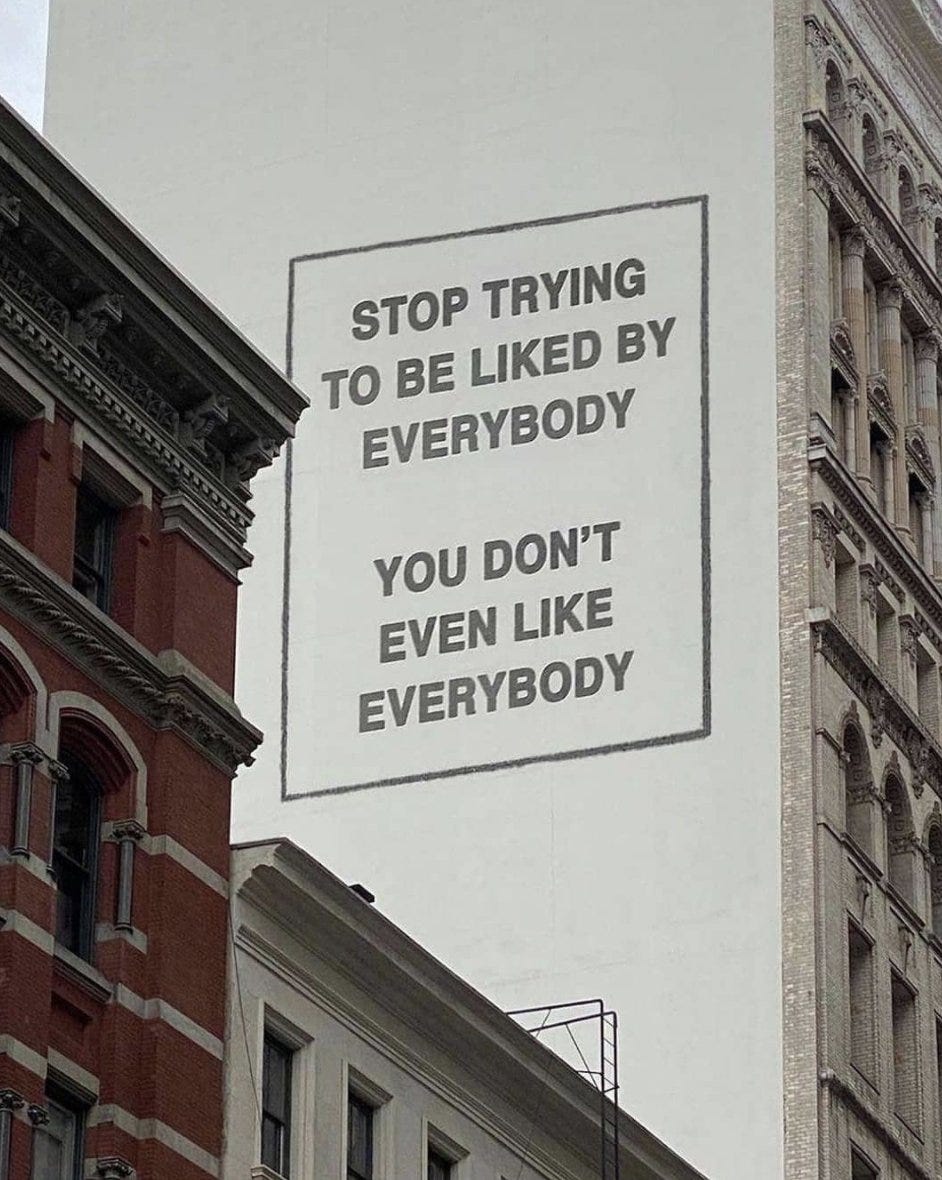
Adam’s post made me think of The Courage to Be Disliked, which completely changed how I think about people-pleasing. The book’s central idea is that we often make ourselves miserable by taking responsibility for things that aren’t ours to control—especially other people’s opinions and reactions. One example that stuck with me is the idea that your task is to live according to your values, while someone else’s task is deciding how they judge or respond to you. You can do your best to earn someone’s approval, but whether they like you is ultimately their task, not yours. That distinction can be incredibly freeing, and I highly recommend the book to anyone who struggles with people-pleasing or worrying too much about what others think.
Hey Adam - I really enjoy your writing but I found myself wishing for a bit more nuance here--I really don't want us to forget that caring for others can be a powerful part of how we express our values.
A few more words:
Yes, abandoning ourselves out of guilt or to please others (who presumably like the temperature of the car) doesn't make much sense. But there are so many other reasons to show up for each other. Saying yes can be it's own form of self-preservation: honoring the part of us that cares about others and recognizes our interdependence.
That can even connect to the preferences you mentioned. Maybe you choose to pull out your jacket in the Uber, not because you're a shrinking violet but because the driver is overheating and it's an act of care. Personal example: recently my mom really wanted to go to the French Open for her 80th birthday, but I'm not a tennis fan. I was excited to show up for her, not because it was people pleasing but because honoring her preference was a way to way to show love.
I've seen that in how you respond to email, using your time to offer encouragement and kind words.
I know we're in a moment of boundaries, and in part that's a helpful correction especially for those socialized to routinely sacrifice themselves for others. I just don't want us to lose that caring for others and incorporating their preferences can be a beautiful part of what makes us the caring people that we are.
Curious if I missed anything or how this lands with other readers and you!
Alex <3